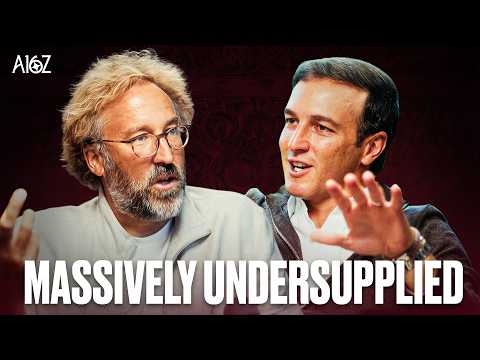
8:11David George: Eric 的观点我换个说法。我们每次和出资人聊,开头都是:这一切会怎么出错?什么会崩?开源会不会让大模型实验室完蛋?我说这完全想错了。这不是「或」,是「和」。前沿模型会很成功,次一代的模型会很成功,开源会很成功,一批应用公司会很成功,云大概没问题,五家大实验室大概都会很好。
20:37Gavin Baker: 但我们应该承认金融市场的历史,一直追溯到南海泡沫。每当出现真正深刻的新技术,汽车、电视、收音机、互联网、个人电脑、铁路、钢铁厂,都会有泡沫,因为市场兴奋、跑到了前面。东西被高估,高估带来过度建设,而用债务融资时尤其危险,因为债务驱动的建设要求立刻有回报,而不是三年后。时间上不能错。即使今天,大部分投入仍来自经营现金流,我认为这很有帮助。而且这轮建设规模太大、我们又太早,已经冲击到很多行业的基础产能:电力和晶圆是根本约束,现在每个做铜的人都有一套 AI 逻辑。如果几百万人就造成了全球算力短缺,到五亿人会怎样?要建多少铜矿?这些约束在拖慢我们,我觉得这对社会其实是好事。
22:43Gavin Baker: 现在我还要加上利率和监管。实际利率在上升,考虑到我们投入这么多,这说得通。监管方面,美国正在发生的事让我很震惊,我们处在一个很糟的位置。上周末我在 X 上和 Anthropic 的 Sholto、和 Dario 有过一次交流。Dario 说他写了两篇文章,一篇正面,一篇负面。但一半负面,而且负面是存亡级的,所有人失业,或者 Eliezer Yudkowsky 说的「造出来,所有人都会死」?为什么不是「造出来,我们治愈癌症,活得更久」?Dario 说过最好的话之一,是我们该停止谈论治愈癌症,真的去治愈癌症。我最喜欢的一句圣经是「真理必叫你们得以自由」,而能讲出 AI 行业真相的,只有 AI 行业自己。
A serious hedge fund manager plus a16z: AI demand is outrunning supply, don't bet against Jensen, and by their own admission this is how bubbles work.
Part 1 of 8 · 1:09
Not a single data point getting worse
AI accelerated across the board in July and August; everyone may win, and revenue is largely in the labs' own hands: which checkpoint to release, how to price, how to split compute between training and inference.
AI accelerated across the board in July and August; everyone may win, and revenue is largely in the labs' own hands: which checkpoint to release, how to price, how to split compute between training and inference. Read this part →
The labs won't have free cash flow; operating cash flow all goes into training. From Nebius and CoreWeave disclosures, payback is 9 to 10 months, financed cheaply by Blackstone and others. Read this part →
Truly heavy users may number under 10 million against 1.5 billion knowledge workers; Atreides' internal token use rose 100x in half a year. Read this part →
The bubble mechanism exists, but data centers are reindustrializing America
Every profound technology brings a bubble and an overbuild, most dangerous with debt; real rates are rising and regulation is bad; data centers transform towns, and cheap gas drives reindustrialization. Read this part →
No spare capacity through 2028, so the price of intelligence may rise; open-source tokens aren't free; this is the age of Elon and Jensen. Read this part →
Chip costs are the same in space and the $15 billion that keeps rising on Earth isn't needed; once launch drops under $1 billion the economics flip. Further out: asteroid mining and Mars. Read this part →
Who becomes the abstraction layer of enterprise intelligence
The future is an ensemble of models, with companies training open models on their own data; Fireworks Nexus is the fullest example; coding wins first because it's verifiable and documented. Read this part →
Vertically integrated and horizontally open, nine chips, 70% to 80% of supply locked up; its data centers are the most financeable, RVGs below gross profit are safe, and open source means more tokens. Read this part →
Indigo's conclusion
The most technical and most credible extreme bull case. But the key point is that bulls and bears aren't arguing right versus wrong; they're arguing timing on the same mechanism, and this time a bull says so himself.
How to read this The most bullish conversation on a16z's own podcast, with full-strength conviction: both are heavily long NVIDIA and SpaceX, and every point talks their book. But Gavin is a serious tech investor with a real record, and he openly concedes the bubble-and-overbuild mechanism and the risk of rising real rates. Read it as the most articulate bull case; the political section is the most partisan and least verified, so discount it heavily.
What to remember
Sub-one-year payback plus financeability is the bull core and a fact both sides share: Gavin reads low risk and not circular, the other side reads fragile residual guarantees.
“Undersupply, not oversupply, and intelligence may get pricier” is the strongest and most falsifiable claim, all resting on demand continuing to accelerate.
NVIDIA as AI's central bank: nine chips, 70% to 80% of supply and the supply chain locked up, open source good for it, every 1% of accelerator share worth about $100 billion.
It independently supports several views: owning your intelligence (Fireworks, Lin Qiao), coding and law winning first because they're verifiable, orbit as the escape from physical limits.
What would change my mind
diffusion disappoints and demand stops accelerating, and undersupply flips to oversupply at once.
How to read this
The most bullish conversation on a16z's own podcast, with full-strength conviction: both are heavily long NVIDIA and SpaceX, and every point talks their book. But Gavin is a serious tech investor with a real record, and he openly concedes the bubble-and-overbuild mechanism and the risk of rising real rates. Read it as the most articulate bull case; the political section is the most partisan and least verified, so discount it heavily.
AI accelerated across the board in July and August; everyone may win, and revenue is largely in the labs' own hands: which checkpoint to release, how to price, how to split compute between training and inference.
00:58 · Not a single data point getting worse
1:09David George: Gavin, you've been on the West Coast this summer, trying to find someone to give you a bearish case and make you more negative. Have you found anybody?
1:23Gavin Baker: No. My standard question is: can you tell me one quantitative data point in your business that's getting worse? Just one. At least in July and August, I haven't found a single person. To be honest, Anthropic is in a quiet period, so maybe they've slowed a little, but I think the rest of the world has accelerated. OpenAI clearly accelerated, open source accelerated more, and Grok, particularly after Grok Bot, has had a dramatic acceleration. AI overall accelerated in July and again in August. It can't keep accelerating forever, but it's wild that public stocks have fallen out of bed over the last two months. You can drown crossing a river that's on average two feet deep: not much action at the index level, but some AI names are in pretty significant drawdowns while things broadly accelerate.
03:02 · Maybe everyone wins
2:42David George: Our friend Eric Vishria said on Patrick O'Shaughnessy's podcast that maybe everyone wins.
2:48Gavin Baker: Anthropic wins, OpenAI wins, SpaceX wins, Meta wins, Google wins by selling a lot of TPUs, open source wins, neoclouds win, the inference clouds on top of the neoclouds win, and applications that execute well win. That feels like a very possible scenario to me, and there's so much zero-sum thinking in the world. On Anthropic, my hypothesis is they probably trued up and cleaned up some accounting, rebased so their revenue definition is comparable to OpenAI's, tested the waters, and because they've executed well, the next disclosure is probably a reacceleration. There's always a funny game between the frontier labs: they always have more advanced checkpoints. Anthropic was clearly waiting for OpenAI to release Astra, and then, magically, Fable 5.1 is available a few hours later. They're heading into an IPO, everyone is shooting at them, and in a quiet period they can't shoot back. I think having OpenAI and Anthropic as public companies will help the market.
5:12Gavin Baker: Anthropic now asks in culture interviews how you'd feel if the equity went to zero, because they want mission-aligned people. That's great, we want missionaries, but we also want people to make money, and you can't afford the compute your mission needs if the equity goes to zero.
5:36David George: They're the accidental enterprise company.
5:40Gavin Baker: The accidental everything. Say one of these labs has 10 gigawatts of power, allocates eight to inference, and monetizes that inference at $60 billion a gigawatt a year. That's $480 billion a year of revenue, a one-year payback on a revenue basis, not a gross-profit basis, and I've tried to use conservative numbers; people think Anthropic and OpenAI are both monetizing at $100 billion a gigawatt today. Now say they have a big research breakthrough and decide it's to their long-term advantage to flip to eight gigawatts of training and two of inference. Annualized revenue goes from $480 billion to $120 billion. I actually think they would make that decision, and public markets will have to get used to it. A lot of the revenue is under their control: which checkpoint they release, where they price along the Pareto curve, how they split compute between training and inference. Meta and Google were fundamentally smooth even when the stocks were volatile.
7:51David George: There was no massive trade-off between the cost of infrastructure and serving revenue. They were totally separate.
02
Payback inside a year, and cheap financing
The labs won't have free cash flow; operating cash flow all goes into training. From Nebius and CoreWeave disclosures, payback is 9 to 10 months, financed cheaply by Blackstone and others.
08:07 · Not "or", but "and"
8:11David George: I describe Eric's point differently. Every LP conversation we have starts with: how is this all going to go wrong? What crashes? Are the labs screwed because of open source? And I say this is all wrong. It's not an "or" thing, it's an "and" thing. The frontier will work really well, N-minus-one models will work really well, open source will work really well, a bunch of application companies will work well, the clouds will probably be fine, the five labs will probably do really well.
8:48Gavin Baker: And NVIDIA is at the center of all of it. The last 26 years have taught me not to bet against Jensen.
9:10David George: On training versus inference: it seems the labs will take all incremental profit, and probably much more, and invest it in training for a long time. That's very different from the internet companies and clouds, which are supply-and-demand driven and throw off tons of profit.
9:47Gavin Baker: To be precise, I don't think they'll generate free cash flow anytime soon. They'll generate a lot of operating cash flow and use it to buy GPUs, XPUs, whatever we call them, or subsidize their first-party products heavily; we know that's happening. Given their belief in scaling laws, which continue to hold, none of them will focus on free cash flow. We saw Satya blink. At Davos he said "I'm good for my $80 billion", they slowed down a little, and I think he regrets it. And Dario famously said some people are being irresponsible with spending: spend too little and you lose share, spend too much and you go bankrupt, and bankruptcy is worse, so he'd rather be conservative. He was conservative, OpenAI was aggressive, and now OpenAI is back in the game.
11:39David George: And SpaceX was aggressive. There are clearly high returns on those decisions independent of the supply-demand mismatch. That seems right short-term and long-term.
11:44 · Payback inside a year, and financeable
11:59Gavin Baker: We calculate it from Nebius's and CoreWeave's disclosures: you can get to a 9-to-10-month payback. You bring on a gigawatt for $50 billion, get an upfront payment of 50% to 60% from customers, so $25 to $30 billion, and monetize the rest in the spot market, where paybacks are faster still. SpaceX builds really big clusters and, importantly, brings them on fast, so it has an even faster payback and monetizes higher. I've shifted to thinking about pricing per megawatt rather than per GPU. In my career there haven't been many opportunities where companies can deploy tens or hundreds of billions of dollars and get sub-one-year paybacks.
13:20David George: And particularly with NVIDIA GPUs, to a lesser extent TPUs, you can finance these at a very low cost of capital today.
13:31Gavin Baker: Everybody is worked up about circularity. I know a lot of smart people at Blackstone, KKR and Apollo, and they're the ones financing it at a relatively low cost. One reason is that useful lives keep getting extended, and as the models improve, the return on token spend goes up, so monetization per gigawatt goes up. The true equity payback might be way inside a year.
14:17David George: You could even argue prices for all of this go up, which would make the supply-side economics more compelling. There's a ton of data that paybacks are within a year.
03
The demand side: we're nowhere yet
Truly heavy users may number under 10 million against 1.5 billion knowledge workers; Atreides' internal token use rose 100x in half a year.
14:38 · The demand side: we're nowhere yet
14:51David George: The knock is that every cycle has an overbuild that destroys supply-side economics. But look at demand. These companies are doing something like $80 billion of revenue on the back of maybe 30 million heavy paying users getting real value, mostly developers.
15:03Gavin Baker: I might take the under on 30 million.
15:07David George: Inside our companies there's a power law in token spend. Old banks spend maybe 1% of compensation, very tech-forward companies high single digits, and within those companies the highest-spending engineers spend 10x or even 100x the median engineer. So 30 million is probably overstated; it might be under 10 million. And there are one and a half billion knowledge workers. It feels like we're nowhere on the demand side, and massively supply constrained.
15:52Gavin Baker: Across the a16z portfolio, what are your best companies spending on tokens relative to human compensation?
16:02David George: High single digits, some at 10%, AI-native ones 10% plus. Old-economy companies doing a good job, maybe 1%. So when people ask whether the supply side is sustainable, pair it with the demand side. Diffusion into the real economy could disappoint, but over a ten-year stretch we're nowhere.
16:40Gavin Baker: At Atreides our internal token consumption went up 100x from March to August. We just got Grok Bot Enterprise, and with two people using it, token spend might go up 10x or 20x in a month. And it's extremely valuable, productive use, not wasted tokens. I'm 50. How old are you, David?
17:45Gavin Baker: You see 23-year-olds who are fluent and native in AI in a way I may never be, no matter how hard I try. I built things with Claude Code, and in about three minutes of typing into Grok Bot I had much better versions of everything. A podcast summarizer, a Substack summarizer, an X summarizer, a sentiment tracker for topics and stocks: each would have taken me hours with Claude Code, and each took 7 to 12 seconds with Grok Bot, and they're better. For me it feels like another ChatGPT moment.
19:18David George: Claude Code was the shift in coding: our best engineers went from 20% of their code with AI to 90% plus. But what you built with Claude Code or Codex was still reactive, summarizing and preparing, knowledge-enhancing. It wasn't doing the work. Now you have a bot that asks: based on everything the other bots learned today, what actions do you recommend? I'm horse-racing Grok Bot, Codex and one of our portfolio companies on that: look at everything I do and recommend automations. Wait until everyone does this and clicks "yes, automate it". That feels like endless tokens.
04
The bubble mechanism exists, but data centers are reindustrializing America
Every profound technology brings a bubble and an overbuild, most dangerous with debt; real rates are rising and regulation is bad; data centers transform towns, and cheap gas drives reindustrialization.
20:30 · Bubbles, rates and regulation
20:37Gavin Baker: But we should acknowledge the history of financial markets, going back to the South Sea bubble. Every time there's a truly profound new technology, the automobile, TV, radio, the internet, the PC, railroads, steel mills, you get a bubble, because markets get excited and get ahead of themselves. Things get overvalued, the overvaluation leads to an overbuild, and it's particularly dangerous if it's funded with debt, because debt-funded buildouts demand immediate returns, not returns in three years. You can't be off on the timing. Even today, the majority of this is still funded from operating cash flow, which I think is really helpful. And the buildout is so big and we're so early that it's hitting the raw productive capacity of whole industries: watts and wafers are fundamental constraints, and now every copper investor has an AI thesis. If a few million people are driving a global compute shortage, what happens at 500 million? How many copper mines do we need? These constraints are slowing us down, and I think that's actually good for society.
22:43Gavin Baker: I'd now add rates and regulation. Real rates are going up, which makes sense given how much we're investing. And regulation: I'm shocked at what's happening in America; we're in a really bad place. I had an exchange on X last weekend with Sholto from Anthropic and with Dario. Dario said he'd written two essays, one positive and one negative. But 50% negative, when the negative is existential, everybody out of a job, or Eliezer Yudkowsky's "if we build it, everyone dies"? How about: if we build it, we cure cancer and live longer. One of the best things Dario said was that we need to stop talking about curing cancer and actually cure cancer. My favorite line in the Bible is "the truth shall set you free", and the only group that can tell the AI industry's truth is the AI industry.
23:25 · Data centers are reindustrializing America
24:05Gavin Baker: You're opposed to data centers? They're probably the best thing that has ever happened to working-class Americans. Going to college might now be significantly NPV-negative, because you can learn to be an electrician, a plumber or an HVAC tech and make ungodly amounts of money. With behind-the-meter power generation, when a data center goes in, it transforms a town: tax revenue doesn't double, it goes up 10x, and it's revitalizing dying small towns. We're getting much better on the environment; they generally use natural gas, a pretty clean fuel. The water consumption thing is totally debunked. It's nothing. Somebody needs to tell that story.
25:15David George: The burden of proof now is delivering tangible everyday benefits for Americans beyond using a chatbot as a search engine, and we're pretty close. One thing that has been correct but ineffective is the idea that we need to stay ahead of China. It's true, and I'm a patriot, but it's way too abstract for the average American. Nobody's worried about China invading America. People care about affordability and how this changes their lives. My favorite example is Loudoun County, Virginia: the highest per capita income county in the US, with the highest density of data centers and tremendous tax revenue from them. Someone opposed to data centers once said, put them in the highest-income county, and that's already where they are.
26:46Gavin Baker: And those talking points are tragic. I think there's an organized, CCP-funded campaign against data centers in America, and a lot of it gets laundered through TikTok. Meanwhile this is reindustrializing America. With the Strait of Hormuz closed, which is amazing for America, natural gas here is $2 or $3 versus $20 or $25 in Europe and Asia, and gas is a key input to electricity, which feeds almost every manufacturing process. So we have a huge cost advantage on a basic input, plus a data center boom. We are reindustrializing America, and it's awesome. It's what both parties have wanted for a long time: small towns left behind when the steel mills closed are coming back. Somebody has to tell that truth; I try on every podcast, but I'm just a dude.
28:00Gavin Baker: Meta is probably doing the best job telling that story, and it's in their DNA. Early on as a public company, Sheryl Sandberg would run through 10 or 15 specific small businesses that started using Meta's ad products: a cake bakery in Des Moines started by two single mothers now has 15 locations and employs 50 people. I'd love to see SpaceX, Anthropic, OpenAI, Google, Meta, NVIDIA, AMD and Broadcom all name real businesses and real Americans and the positive impact on their lives. The truth will set you free, but only if you tell it.
05
Undersupply, not oversupply
No spare capacity through 2028, so the price of intelligence may rise; open-source tokens aren't free; this is the age of Elon and Jensen.
29:03 · Undersupply, not oversupply
29:31David George: Given that fact pattern, it seems more likely that we underbuild on the supply side.
29:42Gavin Baker: Through 2028, for sure. There's no capacity available with all the forecast builds through 2028, which will probably now be delayed by the politics. Everybody's worried about oversupply; I'm more worried about massive undersupply.
30:01David George: In that scenario you could see big price increases to access intelligence, the opposite of where everybody thinks this is going. Dwarkesh had a wild point that the cost of a token could go up 10x. We live in a supply-demand world. The premise of all this is that users are getting a huge surplus; people choose frontier tokens over cheaper ones because the surplus is enormous even at frontier prices. So what happens if there's a massive supply shortage?
31:03Gavin Baker: The funny consequence of the data center degrowthers may be real compute inequality, where big companies and wealthy people can afford compute and others can't, and two years from now they'll complain about it, and it'll be because they wouldn't let us build data centers.
31:21David George: The path to a low-cost mass-market consumer product is advertising, and it takes a long time to build an ad business. There could be a gap when you can't offer that. That would be a terrible outcome for the world, so we need to build a lot of data centers.
31:51Gavin Baker: A compute-inequality future is good for no one, which is another reason open source matters. People think open-source tokens are free. All else equal, it takes the same compute to make an open-source token as a frontier token from a comparably sized model; the question is the margin charged on top. And something people don't appreciate: the Kimi license takes a 30% share of revenue generated on it, because it's open weights, not open source.
32:56David George: And it's extremely token-hungry, so on a task basis it's far less efficient and very costly.
32:47 · The age of Elon and Jensen
33:07Gavin Baker: Jensen is a great patriot, and we're lucky to have him and Elon. When the history of the 21st century is written, like the Victorian age, I think this will be the age of Elon and Jensen, because they're fundamentally altering the fabric of human society and civilization: AI, SpaceX making humanity multiplanetary, Starlink bringing low-cost internet to the poorest communities in the world, which is an amazing consumer surplus people don't talk about.
33:50David George: There was never going to be an economic case to build internet access in those places, given the cost and willingness to pay. Any incremental internet capacity won't be built on Earth in the traditional way; it will come from space.
06
Orbital data centers and SpaceX's future
Chip costs are the same in space and the $15 billion that keeps rising on Earth isn't needed; once launch drops under $1 billion the economics flip. Further out: asteroid mining and Mars.
33:43 · Orbital data centers
34:25David George: Whenever I talk about SpaceX, which is near and dear to both our hearts, I say the orbital data center isn't big buildings in space. People picture the Death Star or the Pentagon floating around. It's more like the size of an airplane: a rack of 72 chips with solar wings, in a sun-synchronous orbit so the radiator is always in the rack's shadow. That's how you cool it. People on X say, "I'm a physics PhD and this is impossible." A friend who is an investor and a physics PhD argued exactly that, then went to a SpaceX day, talked to the engineers, and said, "I was wrong." You may be brilliant, but have you thought about it for ten hours? SpaceX has 10,000 of the world's smartest engineers who've each thought about it for hundreds or thousands of hours with sophisticated tools, and to them it's a solved problem, simpler than a Starlink satellite, which needs phased arrays and has to move around.
36:32Gavin Baker: Assume you're right: there's no physics reason it can't work. On cost it looks imposing, but the history of the Elon companies is that the cost curve gets dramatically better. When we first invested in SpaceX, Starlink wasn't commercially available and we had questions about the economics; same with launch, same with the Model 3. Pair that with the self-inflicted undersupply we'll have on Earth, and at a minimum it will be swing capacity.
37:10Gavin Baker: The question people should ask about orbital compute is Starship reusability. Say a gigawatt costs $50 billion and $35 billion of that is chips. That's the same in space, maybe a bit more. The other $15 billion is power, cooling, labor, all things you don't need in space because you have the solar panel and the big radiator, and that $15 billion is inflationary on Earth, because it's labor, electricians, materials, copper. So you compare it with the cost of launch, and with Starship reusability that goes under $1 billion. The economics instantly flip. You'll always train on Earth; there are advantages to GPUs sitting next to each other, and the speed of light and latency matter, so data centers on Earth aren't going anywhere. But an increasing fraction of the world's compute will be in orbit. Elon said he and Jensen co-designed a Rubin rack launching in the fourth quarter of 2027. Say he's two quarters late: that's 2028. Pretty soon.
38:59David George: As Brad Gerstner says, nobody's really paying attention, and it's happening in plain sight. And you don't even need orbital compute. Starlink mobile has a credible plan and addresses maybe another $800 to $900 billion of wireless revenue, so mobile plus broadband is close to a $2 trillion market, plus a rapidly growing AI revenue base: the cloud business, Cursor, Grok, Grok Bot, and X ads, which from our telemetry are also growing. At some point you'll probably see a Starlink, Grok Bot and X advertising bundle, the way Google built its cloud business by bundling it with ads.
40:55Gavin Baker: Their AI position is heads you win, tails you win. The first-party business is growing very fast and they caught up to the frontier very quickly, which is why they made such aggressive compute investments. And if they overbuilt for their own inference or training needs, they have a very compelling sub-six-month payback on the compute side with massive scarcity. There was a bear case in the OpenAI-Anthropic maximalist view, where those two are the only companies and design their own chips. But they won't have a reusable Starship and multiple spaceports anytime soon, and if orbital becomes where compute makes economic sense, because Starship is deflationary while terrestrial power and cooling are inflationary, then even if SpaceX fumbled its first-party AI applications, it's still a massive infrastructure business.
42:13 · Starbases, asteroids and Mars
42:10Gavin Baker: I'm fired up about Starbase Louisiana. They now have infrastructure for thousands of launches a year, and eventually I think you'll see starbases on multiple coasts all over the world: the Middle East, whichever European country is least bureaucratic at the time, maybe Japan or South Korea. And there's a difference between reusability and what China did. They caught a rocket with a jury-rigged system of wires that had actually been suggested on the SpaceX subreddit more than ten years ago. That's very different from Starship, where the booster is caught, moved, the ship is caught, stacked, fueled and sent right back: two a day per pad, and I think they're engineering the pads for more.
44:10David George: What's the most futuristic thing you think about with SpaceX? At that conference, a group of public investors debated the first $10 trillion company, and you said you had no idea, but you knew which would be the first $20 trillion company.
44:41Gavin Baker: This sounds crazy, but asteroid mining will be very real. The asteroid Psyche has more gold, silver, platinum and every precious metal than exists in the Earth's crust. With Starship, maybe with a lunar base, you'll capture asteroids, bring them into a stable orbit over some American-owned atoll in the Pacific with no humans within 50 miles, have Optimus robots do the work, and delivery to Earth is free, though some of it will burn up. Jeff Bezos said 15 years ago that Earth will be zoned residential: all heavy industry will take place in space, which addresses pollution and everything else. And in the next few years, say eight years at the outside, a fleet of Starships will land on Mars. A modified Starship will open, Optimus robots holding American flags will walk down, set up solar panels, batteries and racks of compute, drop Starlinks, and we'll watch 4K video from robots all over Mars. After that, humans. Think about the moon landing; this is a little bigger.
07
Who becomes the abstraction layer of enterprise intelligence
The future is an ensemble of models, with companies training open models on their own data; Fireworks Nexus is the fullest example; coding wins first because it's verifiable and documented.
47:50 · Microsoft, open source, and the fight to be the abstraction layer
48:01David George: You mentioned Microsoft. Apple made the extreme bet against the future, and Microsoft is a gradient of that. What's your outlook for their decisions?
48:12Gavin Baker: The world has gotten a lot friendlier for their strategy. They clearly tried to make a frontier model and failed; Satya said 18 months ago they'd have very competitive models of their own, and they don't. But I think the future is an ensemble of models. There's a Pareto curve, and no model will be best at everything. For the world's 10,000 biggest companies, you'll take the best open-source model, which in the very near future is probably an NVIDIA model. In a world where open source wins, who funds the training? The chip companies can. A $50 to $100 billion training run is trivial for Jensen. And maybe that's Google's super-long-term play: opt out of the frontier race for now, monetize compute at high rates, sell TPUs externally, generate enormous cash flow while open source gets closer to the frontier. The winner may be whoever has the most cash flow to fund big training runs. I think American open source led by NVIDIA will get really close to the frontier; the Poolside acquisition was made for a reason. That's really good for Microsoft and almost every application software company.
50:18Gavin Baker: You take a strong pre-trained base model, and instead of sharing your enterprise context, which is truly your IP, with a frontier lab, which may be hazardous to your financial health, you do a lot of RL and supervised fine-tuning on your own data. You own it; it's your model. If intelligence is a critical input to your business, you want to own and control its capabilities and its cost. My understanding is that Grok Bot runs something like Gemini 3.7 Flash, Grok 4.6 and some Opus behind a router. Companies will have their own model on their own data working with one or two frontier models, transparent to the user, the most capable one for planning and cheaper ones for execution. That's a much friendlier future for Microsoft than one with only two dominant frontier models, and it looks like there'll be at least three with Grok. And give Meta credit: they were out of the game and got back in. A year ago, when Gemini was ascendant, who would have imagined Gemini wouldn't even be in the conversation and Meta's Muse would be significantly ahead? It's the highest-stakes game of corporate chess ever played.
53:00David George: I think the best broad instance of that today, outside Grok Bot, Cursor and some of what Harvey has done, is Fireworks' Nexus product: choose your frontier model, and they'll take whatever open-source model you want and RL it on your data, for Goldman Sachs, Morgan Stanley, JPMorgan, Fidelity, a16z, so you control your intelligence, all transparent behind a router. That's clearly what Lin at Fireworks said first, and then Alex Karp and Satya each took their own version of it. But it's really hard to do. The way I describe it: who gets to be the abstraction layer of intelligence for the organization and its users? It's the most valuable position I can imagine in the history of business.
54:21Gavin Baker: Who's the arbiter of intelligence for global enterprises, and probably consumers. I was a retail analyst, and everybody thinks running a big chain is easy. America is so big that almost any retail category is worth over $50 billion. All you have to do is run a thousand stores in 50 states with different climates and preferences, stocked with the right products at the right time and price for each region, staffed by friendly, knowledgeable employees who don't steal from you and turn over at least 100% a year, with clean, well-lit stores, and presto, $50 billion. In the history of American business you don't have to count very far. Being that abstraction layer, working seamlessly, is way harder than people think.
55:42David George: What's interesting about Cursor: everyone else in the lab space was creating a digital deity, AGI and ASI, and the Cursor guys just wanted to make a great product. Of everybody at the frontier, they were probably the most product-focused, and now they're part of SpaceX, which suits Elon's mindset: make it an engineering problem, build the model factory, then build a great product. They had a similar end-state vision as the others, just a practical path: meet the customer and the technology where they are, and work up toward autonomy from there. And coding is unique in knowledge work, which supports the bull case for Microsoft as that layer: it's verifiable and perfectly documented, and nothing else in the enterprise is. The rest will be messy. Linking my Copilot to all my stuff, training a model on our data, convincing me you won't share it, putting it behind a seamless router and continuously upgrading the open-source base: that isn't middleware, it's very hard. And they'll compete with the labs, Databricks, Palantir, the inference providers and application companies. Harvey has done an incredible job in legal, which is also unique because it's well documented and somewhat verifiable, and tax will be similar, but the broad one-and-a-half-billion-worker prize will be very messy to get.
58:40Gavin Baker: And the category is massively validated: Kirkland & Ellis said it will spend $500 million to build this itself. Good luck, that's very hard, and it isn't a one-time build; the model has to be continuously updated, the base model swapped out, all transparently. But it tells you the pie is huge. There will be a big collision between Fireworks Nexus, legal and coding agents, Microsoft, Databricks, Snowflake, Salesforce, Workday. It will come down to who executes best and who has the lowest costs, and you won't be the low-cost provider over the long term unless you're vertically integrated and own your compute. That's another reason I increasingly look at hyperscalers on enterprise value to net PP&E: net PP&E is compute, and the ratio shows what the market thinks you'll monetize your fleet at. It's an AI version of price to book.
08
NVIDIA as the central bank of AI
Vertically integrated and horizontally open, nine chips, 70% to 80% of supply locked up; its data centers are the most financeable, RVGs below gross profit are safe, and open source means more tokens.
1:00:10 · NVIDIA as the central bank of AI
1:00:27David George: You mentioned Jensen. I share your view that he's carrying this industry forward. Tell me your thoughts on NVIDIA.
1:00:37Gavin Baker: He's in a very, very good position, with a strategy of being vertically integrated but horizontally open. Say some really, really good accelerator emerges: it will almost certainly be better if it plugs into his ecosystem. If you're a semiconductor CEO, the only thing you should ever say is: thank you, Jensen, for creating this opportunity; how can we work with you? Sure, compete at the edges. My rule of thumb is that every 1% of accelerator share today is worth about $100 billion, so there's no need to go head-on with NVIDIA. Pick a niche and get your 1%. He has nine chips: several kinds of accelerators, CPUs, Ethernet switches, two kinds of GPUs, and networking that went from scale-out to scale-up, scale-across and now scale-in. His biggest customers all have products competing with some of those nine chips. Just plug in, and be nice to him. Have you seen game tape of the Chicago Bulls when Jordan is a little bored in game 50, up eight games in the conference, and some young player decides to talk trash because they're winning? Don't do that.
1:03:02Gavin Baker: It matters because Jensen's data centers are financeable. Say an NVIDIA data center costs $50 billion: you need a $15 billion equity check and can finance the other $35 billion. It's not circular financing. I have a lot of respect for the people at Blackstone, KKR and Apollo who underwrite each of those. And there's a residual value guarantee; as long as that guarantee is less than the gross profit dollars he makes selling chips into that data center, it's super NPV-positive with very little risk for him, plus he gets a revenue share. His data centers are the most financeable. TPUs are probably second, and that probably takes double the equity check at least, with higher rates on the rest. Cost of capital is a huge advantage. He's also acquiring land, power and shell companies and matchmaking them with offtake agreements. I think one reason he does RVGs is that without them it's an Anthropic- and OpenAI-dominated world, since they can pay the most for compute. He helps others compete with them, the same way he stood up the neoclouds in the first place. It's democratizing compute, and his incentives around fragmentation of AI, models and power are completely aligned with what's good for America.
1:05:22Gavin Baker: I can't take it when people think open source is a giant risk to his business when Jensen is the world's biggest advocate for open source. It's amazing for his business. Instead of a 90% margin on top of a token made with an NVIDIA GPU, maybe it's a 40% margin, so more tokens get consumed, which means more compute, in a supply-constrained world where he has locked up 70% to 80% of supply. Fab capacity, DRAM, NAND, lasers, capacitors, everything you need to make the racks, because he saw this coming before everybody else. Fifteen years ago he said he was making a $2 or $3 billion bet every two years and moving really fast. Now he's making multi-hundred-billion-dollar bets, bringing the supply chain and the financing alongside him by standardizing it and making it easy for Blackstone, KKR, Apollo, Goldman, Morgan Stanley and JPMorgan to finance. That is hard to compete with.
1:07:06Gavin Baker: My firm, Atreides, has a pretty big private portfolio of semiconductor companies, and Elon said a lot of people will learn hard lessons in hardware. I've learned a lot of hard lessons in semiconductor investing. You back the best team, tape the chip out, feel great about the emulation and simulations, the chip comes back from the fab, you get a FaceTime from the CEO as they plug it in, and sometimes it doesn't work at all. Then you might be back to the drawing board needing hundreds of millions or a billion dollars more, two years later, assuming you can get financing. Hardware is hard, and what he's doing, at his scale and speed, bringing land, power, supply chain and financing along, means you want to plug into that ecosystem.
1:09:08David George: That's part of why Elon made the decision he made, which I think was a very high-Elo move. Everybody else tried to build their own ASIC and sometimes took shots at NVIDIA on stage. I'll give credit where it's due: Jalapeño, which we saw last night, is the first good ASIC I've seen from a lab other than TPU or Trainium, built in what seems a pretty short time. If you're a lab with the model and you can see the direction of research, that's a big advantage for designing your own chip. But NVIDIA works with everyone, and people keep expecting things to standardize, while the three big Chinese open-source models, DeepSeek, Kimi and Qwen, are evolving in very different ways; you need general-purpose chips for that kind of evolution. And Jalapeño is competitive with one of his nine chips. To compete at the system level you need eight more. As Dylan at SemiAnalysis says, he's the central bank of AI, the Federal Reserve of AI. Instead of competing with someone fully aligned, Elon partnered, and history will judge that wise.
1:12:09Gavin Baker: In a world this supply constrained, it's hard to tell true customer preferences; people take anything, which is why old H100 prices have held up so well, and if you have TSMC allocation and the DRAM to pair with it, you'll sell out. One of the best ways to see true preferences is the kind of deals customers cut with chip companies. First, the chip company invests in a customer, as Amazon and Google did with Anthropic for Trainium and TPU, which solved the cold-start problem and helped those chips level up; as long as the dollars invested are less than the gross profit, you can't lose. Second, the RVG, financed by Blackstone, Apollo, KKR or Goldman; as long as the guarantee is below your gross profit you can't lose, and you probably get a revenue share on top. Third, warrants tied to a fixed price per million tokens; as long as your chip's performance outruns your stock, you do fine. Giving warrants away with no such terms can be NPV-negative. You can infer something about true customer preferences from that hierarchy, and NVIDIA does pretty good deals.
Where Indigo landsFurther
Indigo's conclusion
The most technical and most credible extreme bull case. But the key point is that bulls and bears aren't arguing right versus wrong; they're arguing timing on the same mechanism, and this time a bull says so himself.
What to remember
Sub-one-year payback plus financeability is the bull core and a fact both sides share: Gavin reads low risk and not circular, the other side reads fragile residual guarantees.
“Undersupply, not oversupply, and intelligence may get pricier” is the strongest and most falsifiable claim, all resting on demand continuing to accelerate.
NVIDIA as AI's central bank: nine chips, 70% to 80% of supply and the supply chain locked up, open source good for it, every 1% of accelerator share worth about $100 billion.
It independently supports several views: owning your intelligence (Fireworks, Lin Qiao), coding and law winning first because they're verifiable, orbit as the escape from physical limits.
Claims you can check later
Claim
Who
When we will know
How firm
Through 2028, undersupply rather than oversupply; the price of intelligence may rise (tokens up perhaps 10x)
Gavin, David
Through 2028
First-hand; heavy book; a continuity bet
New compute pays back within a year, can be financed cheaply, and isn't circular financing
Gavin
Now
First-hand; backed by Nebius and CoreWeave disclosures
Orbital compute economics flip instantly with a reusable Starship, and more compute moves to orbit
Both
From Q4 2027 into 2028
First-hand; a bet on Starship, unproven
The future is ensembles of models plus companies owning their intelligence (open models trained on their own data), which suits Microsoft
Both
Next few years
First-hand; directional
Back on the long-running theses
adds to
AI capex as a single engine and the shape of demand “Undersupply, not oversupply; demand is nowhere yet” is the most technical bull testimony on the “demand is real” side.
confirms
Cathie Wood's deflationary boom The same bullish pole: Cathie reads $50B per GW as proof of returns, Gavin reads an RVG below gross profit as low risk.
Lin Qiao (Fireworks): post-training is how you keep your taste a16z names Fireworks Nexus as the best abstraction-layer example, confirming that moat from the investor side.
confirms
The SpaceX CFO at Goldman Same week, same story: here the orbital economics are restated independently and broken down, with the same continuity bets still to be checked.
What would change my mind
diffusion disappoints and demand stops accelerating, and undersupply flips to oversupply at once.
Finished. Indigo's take on this piece is in two places: